AIDROGEN

AIDROGEN

A 125-billion-parameter model, served at home from a used workstation.

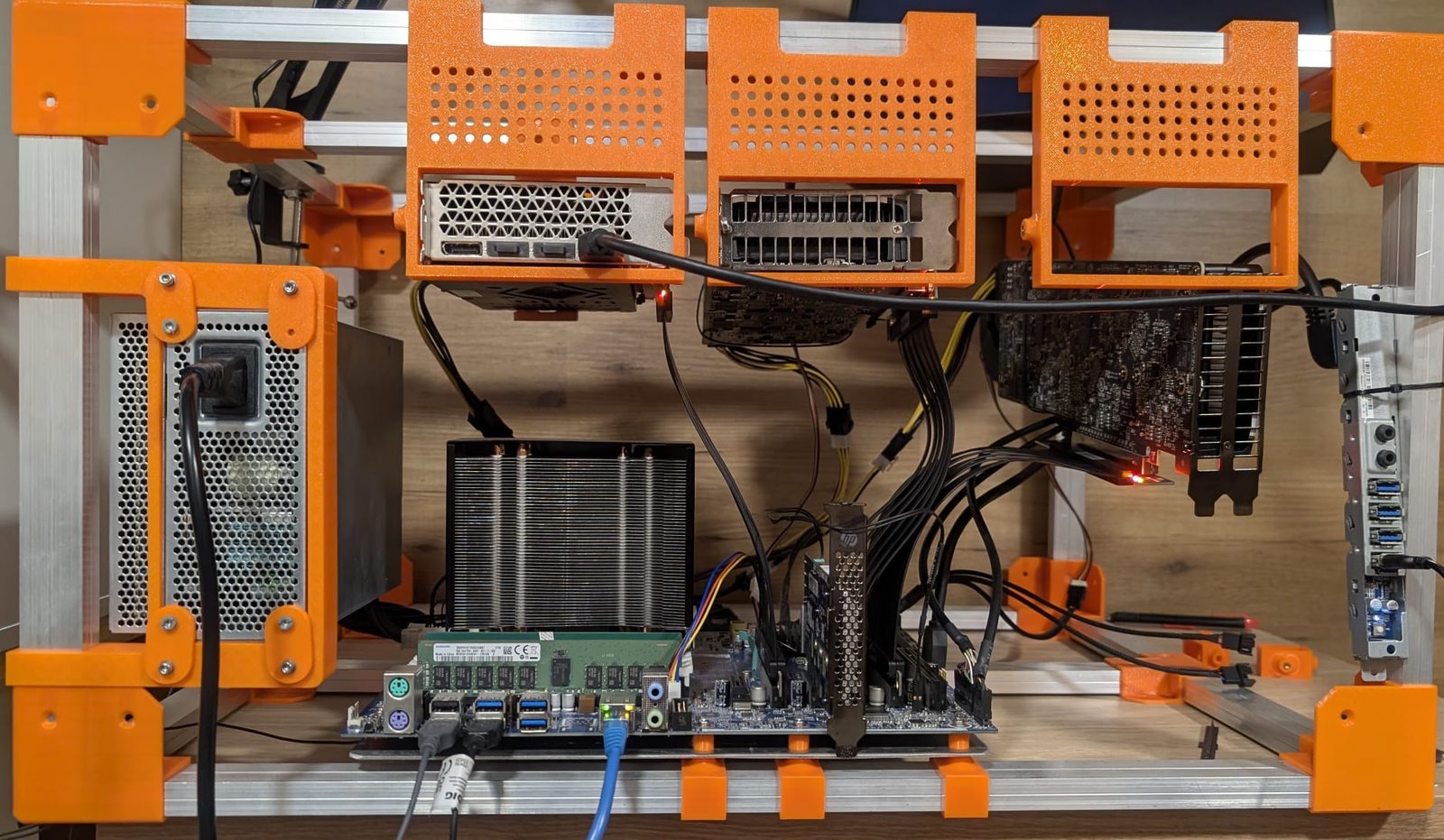
One RTX 3060 and two Tesla M10 cards, cards that data centres retired years ago, run Qwen3.8-Flash-Next at its best-quality quantization, with 128k tokens of context. Every number on this page was measured on the machine in the photo.

The aidrogen rig: an open aluminium frame with orange 3D-printed parts. Three graphics cards sit in printed cradles along the top, the motherboard with its CPU cooler lies on the bottom, and the power supply stands on the left.
  1. 1RTX 3060 12 GB: runs the shared layers and holds the busiest experts
  2. 2Tesla M10, first card: four GPUs of 8 GB
  3. 3Tesla M10, second card: four more GPUs of 8 GB
  4. 4HP Z440 power supply
  5. 5Xeon E5-1620 v4 under its cooler
  6. 6NVMe SSD on a PCIe adapter
  7. 7Open frame: aluminium profiles and 3D-printed parts

What runs here

Qwen3.8-Flash-Next is a mixture-of-experts model: 125 billion parameters in total, but only about 6 billion are used for each token. Most of the weight sits in 24,576 small "experts", and every token calls just a few of them.

That is what makes cheap hardware useful. The experts do not need a fast GPU; they need a lot of memory close to a GPU. A Tesla M10 is four small GPUs on one card, 8 GB each, built for virtual desktops and now sold off by data centres. Two of them give 64 GB of video memory, enough to hold the whole model next to the RTX 3060.

What was built

The engine is Strata, with the Maxwell support of Strata-maxwell. That fork drove up to four M10 GPUs and only 2-bit expert formats.

This project extends it to eight M10 GPUs and adds the kernels the M10 was missing for the IQ3_S model: three new input formats and a new output stage, rewritten so the old cards read memory efficiently. Each new kernel was checked against the RTX 3060's own results before it was allowed to run.

The machine

Nothing here is new hardware. Only the frame is custom.

PartWhat it isIts job
WorkstationHP Z440, Xeon E5-1620 v4 (4 cores, 8 threads)Host. The CPU runs the server and feeds the GPUs.
Main GPUNVIDIA RTX 3060 12 GB, slot 2, PCIe Gen3 x16Attention and shared layers, the speculative draft head, and a cache of the 1,267 busiest experts.
Expert GPUs2 × NVIDIA Tesla M10 (4 × GM107, 8 GB each), slots 4 and 5The other 23,309 experts, split across eight dies.
Fast storageNVMe SSD (Samsung SM951/PM951), slot 3The IQ3_S model and its prepared pack. Loads in about 4 minutes.
Archive storage1 TB hard diskThe IQ2_XS model and the full system backup.
Power limitsRTX 3060 at 120 W, each M10 die at 30 WMeasured: more power to the 3060 gave a higher clock and no extra speed.
FrameAluminium profiles, 3D-printed cradles and corners, PCIe riser cablesHolds three double-width cards that the Z440 case cannot.

How the cards are wired

PCIe topology of the rig The CPU connects to the RTX 3060 in slot 2 at Gen3 x16, to the NVMe SSD in slot 3, and to the two Tesla M10 cards in slots 4 and 5. Each M10 has a PLX switch: the switch links to its four GPUs at Gen3 x8 but to the host only at Gen1, x8 in slot 4 and x16 in slot 5. Xeon E5-1620 v4 PCIe root complex slot 2 · Gen3 x16 · 12.05 GB/s slot 3 slot 4 · Gen1 x8 · 1.58 GB/s slot 5 · Gen1 x16 3.14 GB/s RTX 3060 12 GB CUDA0 · bus 07:00.0 NVMe SSD model files Tesla M10 · PLX switch bus 01:00.0 Tesla M10 · PLX switch bus 08:00.0 1 2 3 4 5 6 7 8 CUDA1–4 · buses 03–06 8 GB each CUDA5–8 · buses 0A–0D 8 GB each Each die links to its switch at Gen3 x8; the four dies share the switch's uplink.
Measured on the rig. The M10 slots are forced to PCIe Gen1 in the BIOS on purpose: at Gen3, with an NVMe drive next to an unshielded riser, the link produced about 10,500 correctable errors per second. Gen1 took that to zero.

Results

IQ3_S, the best-quality quantization, is about 10% slower than the 2-bit IQ2_XS. On a coding agent that trade is worth it: fewer wrong answers mean fewer rounds of corrections.

Generation speed in tokens per second City prompt: IQ2_XS 56.6, IQ3_S 51.3. Code prompt: IQ2_XS 64.0, IQ3_S 57.3. Mean of six runs: IQ2_XS 60.3, IQ3_S 54.3. 0 20 40 60 tok/s City 56.6 51.3 Code 64.0 57.3 Mean 60.3 54.3
Same engine binary for both models, thinking on, 600 tokens, temperature 0, three runs per prompt.
IQ3_S in productionMeasured
Reading a prompt (prefill)178–183 tok/s
Writing, 64k context50.4 tok/s
119,275-token prompt: needle found44.7 tok/s
Load time from the SSD251 s
Free memory left on the 3060~1 GB
10-minute soak, 84 requestsno errors

The new output stage reads its weights as 16-byte blocks instead of 2-byte pieces. On the M10 it went from 271 to 118 microseconds per layer, and its results are identical to the old kernel bit for bit.

Two models, one switch

IQ3_S: the default

Highest-quality quantization of the model. 54.3 tok/s on coding prompts, 128k context, loads in about 4 minutes from the SSD. Used for real work.

IQ2_XS: the fast one

2-bit quantization, about 10% faster: 60.3 tok/s on the same prompts. Kept on the hard disk and ready with one command; loads in about 11 minutes from there.

Both models cannot sit in video memory at once (about 31 and 47 GB of experts against 76 GB in total), so switching means reloading.

How it got here

Built by one person, on a used workstation, over two weeks of evenings and nights.

  1. A storm of PCIe errors

    The first M10 produced about 10,500 correctable errors per second. The cause was electromagnetic: the NVMe drive sat next to the card's unshielded riser. Moving the drive to slot 3 and forcing the M10 slots to Gen1 brought it to zero.

  2. A full backup, and a driver experiment

    The whole system was imaged to a hard disk before any risky change. A driver unlock was then tested: +2.5% on prompt reading, nothing on writing. It was removed.

  3. The second M10, and eight GPUs instead of four

    The engine accepted at most four M10 GPUs. Seven places in the code were changed to accept eight. IQ2_XS reached 68.7 tok/s in a real coding session.

  4. IQ3_S refuses to start

    The M10 kernels only understood 2-bit formats, and a safety check stopped the engine. The check is right: a format read with the wrong kernel gives plausible but wrong answers.

  5. New kernels, checked against the 3060

    Three input formats and a native output stage were written for the M10, each compared with the RTX 3060 to one part in 100,000 before use. IQ3_S loaded on all eight GPUs for the first time.

  6. The planar output stage, and production

    Profiling showed where the time went. The output stage was rewritten for the M10's memory and became 2.3 times faster. IQ3_S passed the 128k test and a 10-minute soak, and went into service.

What did not work

Each idea below was tested, one change at a time, and the measurement said no.

The ideaHow it was testedWhat the measurement said
Power the M10 from the CPU's EPS connectorNVIDIA datasheetIt needs a PCIe 8-pin. The EPS cable can damage it.
The PCIe errors depend on temperatureErrors and temperatures, minute by minuteThey changed at constant temperature.
The riser cable is faultyTwo different risers at Gen3Same error curve with both.
Reading the PLE table slows prompts downTwo read modes compared152 against 152 tok/s.
The driver unlock speeds things up a lotBefore and after, same tests+2.5% prompt reading, 0 on writing.
Raising one limit is enough for eight GPUsSearch for every 4-element arraySeven code changes were needed.
The new M10 is defectiveEach card alone, six identical promptsBoth gave the same answer to the bit.
IQ3_S runs on the M10 with a config changeFirst start, then the source codeThe kernels did not exist. They had to be written.
Heavier experts make IQ3_S about 40% slowerSame prompt, same engine−20% with the first kernel, −10% with the planar one.
The M10s are held back by their 30 W limitPower and clocks sampled every secondThey draw 21–23 W. Their clock cannot be changed with this driver.
A stronger 3060 means more speed120 → 140 → 120 W+5.5% clock, same tokens per second. The 3060 waits for the M10s.

Rebuild it

The outline is here. The exact commands, configuration and checks are in the full guide.

  1. Hardware

    A workstation with three usable PCIe slots, PCIe 8-pin power for each M10, risers, and airflow: the M10 is passively cooled. Keep NVMe drives away from unshielded risers.

  2. BIOS

    Set the M10 slots to Gen1 explicitly; "Auto" is not enough. On the Z440, add pci=realloc to the kernel command line so both M10 switches get their memory windows.

  3. Host and driver

    Proxmox VE 9 with the kernel pinned, and NVIDIA driver 580.196.07, the last branch that supports Maxwell. Keep the installer file: you will need it again.

  4. Container and CUDA

    A privileged Debian 12 LXC with the NVIDIA devices passed through, and CUDA 12.9. CUDA 13 no longer supports the M10.

  5. Engine

    Build the iq3 branch with a recent CMake (the 3.25 of Debian 12 cannot handle CUDA 12.9's C++20 dialect).

  6. Model

    Download and prepare Qwen3.8-Flash-Next IQ3_S with Strata's setup.py: about 84 GB of model files plus a 49 GB prepared pack.

  7. Configure and start

    Eight Maxwell devices, the CUDA order with the 3060 first, an expert cache of 988, 128k context. At start the log must show eight round-trip gates passed.

  8. Measure

    Use the bench tool with a fixed protocol and compare only runs made the same way, in the same session.

Want to learn to build this?

Running a large model at home is a chain of skills: choosing hardware, reading a datasheet, driving a coding agent, measuring instead of guessing. None of them is magic, and all of them can be learned.

The Rizzo AI Academy, led by Simone Rizzo, teaches them with courses, weekly live sessions and a community of people building with AI: language models, local AI with tools like Ollama and LM Studio, agents, coding agents and more. The courses are in Italian.

Full disclosure: I am a moderator and contributor there. If this page made you want to try, that is where to start.

Visit the Rizzo AI Academy

Credits

  • Strata, by Niko1221 and contributors: the engine, the server, the whole architecture.
  • Strata-maxwell, by nuke1984: the Maxwell tier this work extends, its first kernels and its safety checks.
  • Qwen team: the Qwen3.8-Flash-Next model.
  • ISTA-DASLab: the GSQ-RCO quantization and the IQ3_S files.
  • ggml / llama.cpp: the quantization formats and the reference arithmetic the new kernels follow.

This project did not invent the arithmetic; it moved it onto older hardware and measured every step. The mistakes are Craicek's, not theirs.

The code is MIT licensed, as upstream. Source, campaign log and every raw measurement: BitMakerMan/Strata-maxwell-IQ3_s, branch iq3.